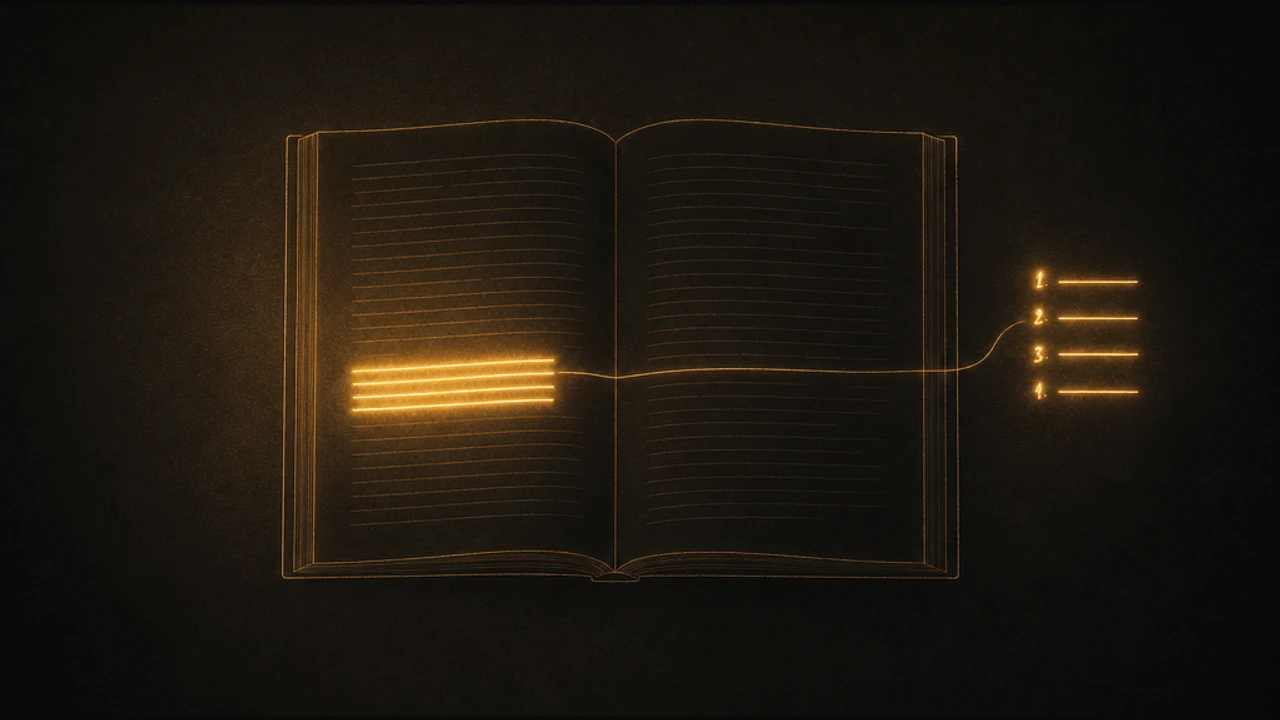
Take notes on a book in two passes. While you read, mark only what you would want to find again, and keep the marking cheap: a line, a sticky tab, a page number written inside the front cover. After each reading session, close the book and write two or three sentences from memory. The marking is what lets you find a passage a year later, the writing from memory is what makes the book stick, and collapsing both into one habit is why people fill a whole notebook with three books and remember none of them.
That last failure is the common one, and it is not a discipline problem. Almost every guide on this question describes a single activity called taking notes and quietly lets you assume it does both jobs at once. It does not. Below is what each job needs, which parts of the standard advice survive contact with the research, and a stopping rule for when you have written enough.
Why do book notes turn into a transcript?
Ask people who take notes on books what goes wrong and the answers rhyme. On the Art of Memory forum, one reader described filling one notebook with three books, recopying the text instead of keeping the ideas. The long r/books threads on the same question read much the same. Nobody in those discussions is lazy. They are working hard and ending up with a transcript.
Copying feels productive while it is happening. The sentence is right there, it is clear, and writing it out feels like taking possession of it. The same forum thread contains the sharpest statement of the problem: what works best does not feel as effective as highlighting or copying does. That gap between how a technique feels and what it leaves behind is the whole difficulty, and I went through the mechanism separately in why you can't retain information.
What are the two jobs a book note has to do?
A note about a book does one of two things, and the two pull in opposite directions.
| The note that finds it again | The note that remembers it | |
|---|---|---|
| Written | while you read | after you close the book |
| Copied from | the page | your memory |
| Good version | fast, literal, carries a page number | slow, lossy, in your own words |
| Test of quality | you find the passage in a minute | you can state the idea without the book |
Read down those columns and the conflict is obvious. A good capture note is complete and cheap, so you write more of them. A good memory note is incomplete and expensive, and writing more of them defeats the point, because the effort of dragging the idea out of your head is the part that does the work. Highlighting is a decent tool for the left column and a poor one for the right, which is exactly why it disappoints people who expect it to do both.
Does highlighting actually work?
Not for the right column, and this is the best documented part of the question. Dunlosky and colleagues reviewed ten common study techniques in Psychological Science in the Public Interest 14(1), 4-58, rating each on how widely its benefits generalize. Highlighting and underlining were placed in the low utility group. So were summarization and rereading. Two techniques were rated high: practice testing, meaning retrieval with the material out of sight, and distributed practice, meaning spacing your attempts across days.
Low utility does not mean useless, and the review is careful about that. It means the benefit fails to hold up across different readers, materials and tests. The cleaner way to read the ranking is as a statement about which job each technique does. Marking a location on a page is genuinely useful, and nobody should stop doing it. It is simply not the step that puts the idea into your head, and most pages currently ranking for this question prescribe underlining as though it were.
Marking well is a smaller skill than note taking and worth getting right on its own terms, since the volume you mark turns out to predict how much the marking costs you: how to annotate a book has the measurement and the rule that follows from it.
What should you write, and when do you stop?
Here is the piece the standard advice leaves out. Every guide tells you what to write. Almost none of them gives a rule for how much, so the answer defaults to more, and more is how a notebook fills with three books.
The marking pass, while reading. One criterion: would I want to find this again? Not is this interesting, because everything in a book worth reading is interesting. Underline it, tab it, or write the page number inside the front cover with two or three words. It takes seconds and does not break the reading.
The recall pass, after you stop. Close the book. Write two or three sentences about what that section argued, from memory, in your own words. Then open it and check yourself. The checking is not optional, and the gaps you find are the valuable part, because those are the ideas you believed you had. If you close the book and can produce nothing at all, do not go back and copy the passage out. Reread the section and try again.
Two or three sentences per session, not per chapter, is the stopping rule. If your notes run consistently longer than that, you are copying rather than remembering. The full evidence ranking behind this method is in how to remember what you read.
Then the second half of the Dunlosky result, which almost no note-taking guide acts on. A recall pass on the day you read is worth less than the same pass repeated after a gap. In practice that means reading your own two sentences before the next session and trying to state the previous chapter's argument before starting the new one. It costs about a minute and it is the cheapest thing on this page.
Does it matter whether you write by hand?
Less than you have been told. The claim that longhand beats typing traces back to a single study, Mueller and Oppenheimer's The Pen Is Mightier Than the Keyboard in Psychological Science 25(6), 1159-1168. Note-taking articles quote it constantly, almost always without the sequel.
The sequel is a direct replication by Morehead, Dunlosky and Rawson in Educational Psychology Review 31(3), 753-780. Longhand did beat laptops on factual questions in one experiment. There was no difference on conceptual questions, no effect at all on a test two days later, and their meta-analysis across the experiments found small effects that were not statistically significant. What did predict performance was whether the notes actually contained the material the test asked about.
Both studies used lectures rather than books, so treat this as a limit on the advice rather than a finding about reading. The practical reading holds anyway: put your attention on what goes into the note, not on which pen wrote it. Pick the medium you will still be using in a month.
If the medium you pick is an app that syncs your ebook highlights and mails a few back each morning, the question becomes which of them still does the mailing: Readwise alternatives sorts them by that, since most drop the review and keep the sync.
What if you are listening instead of reading?
Everything above assumes hands, eyes and a margin. A large share of nonfiction now reaches people as audio, and every marking technique in the top search results fails at 100 km/h with both hands on the wheel. Two things have to change. Marking has to cost a single gesture, because anything requiring a screen will simply not happen. And the recall pass has to move to the next natural stop, which is a feature rather than a compromise, since the gap between listening and recalling is the spacing the research asks for.
I build Graspd around that split, so read this paragraph with that in mind. Marking a moment is one tap or one spoken word while the audio keeps playing, and afterwards it asks you questions about what you heard, capped at your listening position so nothing later in the book can leak into a question. That is the recall pass, moved to a moment when your hands are free.
The limits belong here too. Audible files are DRM protected and cannot be imported by Graspd or any other third party tool, so this covers podcasts and audio you own outright. The free tier includes three hours of podcast audio a month, one recap and one quiz a week, and ten companion messages a day, while uploading your own audiobook files needs a paid plan. The capture half for audio is worked through in taking notes from podcasts without stopping, and the memory half in how to remember what you listen to.
FAQ
How do you take notes on a book you don't own?
Use the front cover method on a sticky note instead of the page: a page number and two or three words for each passage worth returning to. For a library book, that slip becomes your whole capture layer. The recall pass is unaffected, since it gets written from memory rather than from the page.
Should you take notes while reading or after reading?
Both, but different notes. While reading, mark locations only, which should take seconds and never interrupt the flow. After you stop, write two or three sentences from memory and then check them against the book. The first note helps you find things later, the second is what actually builds the memory.
How many notes should you take per book?
Fewer than feels right. Two or three sentences per reading session, plus however many location marks the book earns. A chapter that yields one good sentence you can produce from memory has done more for you than four pages of copied quotations that you will never open again.
Is it better to take notes by hand or on a laptop?
The evidence is weaker than the advice suggests. The 2019 replication by Morehead, Dunlosky and Rawson found a longhand advantage only on factual questions, none on a delayed test, and small effects overall that were not significant. What mattered was whether the notes contained the tested material. Use whichever medium you will keep up.
How do you take notes on an audiobook?
Mark the moment while it plays, then write from memory once you stop. Marking has to be one gesture, such as a tap or a spoken word, because anything needing a screen will not survive contact with driving or dishes. Note that DRM protected Audible files cannot be imported into third party tools.