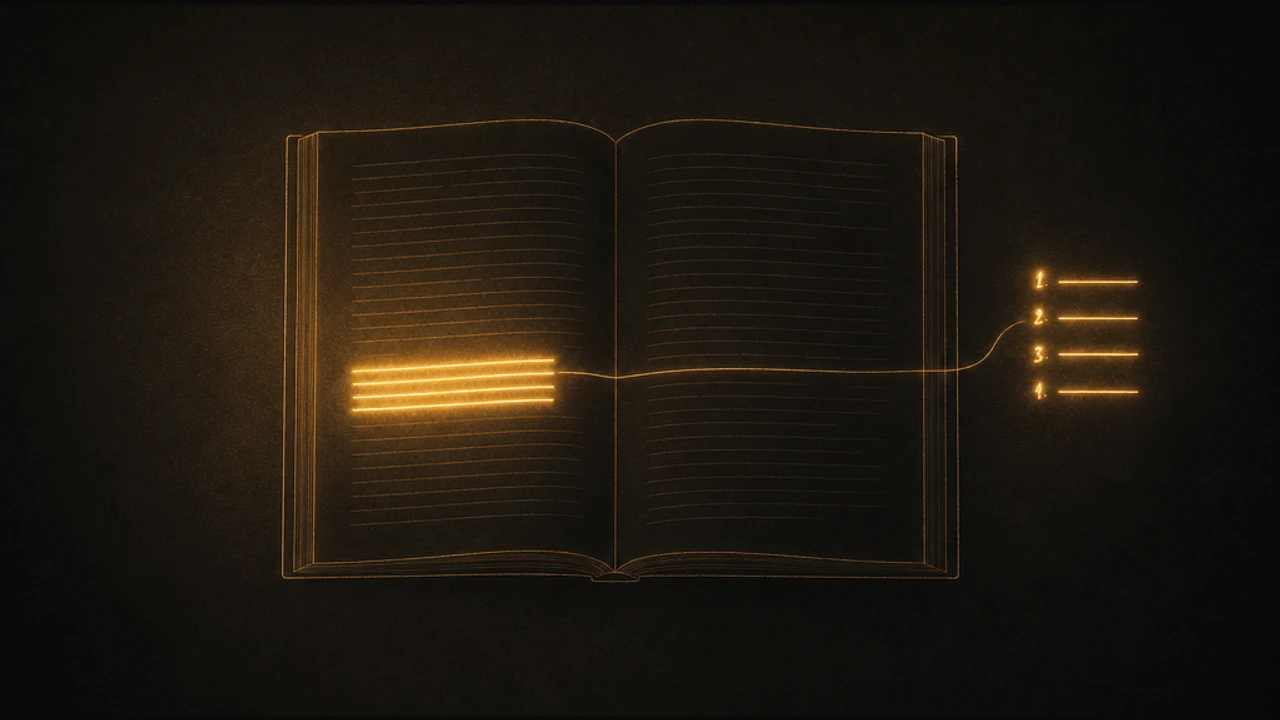
A commonplace book is a personal collection of passages worth keeping, copied out of what you read and filed by subject instead of by date. Keeping one takes three habits: mark while you read, copy the marks out in a separate sitting, and reread on a schedule. Nearly every guide covers the first two and treats the third as optional. The third is the one that decides whether you end up with a resource or a drawer of quotations nobody opens.
The practice is about two thousand years old, and it survived that long because it solved a problem most people no longer have. Working out which part of it still earns its place is most of what follows.
What is a commonplace book?
It is a notebook, on paper or on a screen, where you copy passages that struck you: quotations, arguments, definitions, anecdotes, a phrase you want to steal later. What separates it from a journal is the filing. A journal runs in date order and records your own life. A commonplace book runs in subject order and records other people's sentences, so the entries on courage sit together no matter which year you read them.
Seneca described the method in one of his letters as a bee gathering from many flowers and then making something of its own. Marcus Aurelius, John Milton, Thomas Jefferson and Virginia Woolf all kept one. Isaac Newton worked out early calculus in a notebook he called his waste book. Ronald Reagan kept his on index cards, published after his death. The list is long enough that every article on the subject uses it as the argument for the practice, which is where the trouble starts.
Why did Locke keep one, and do you need to?
John Locke wrote his method in French in 1685; it reached English readers in 1706 as A New Method of Making Common-Place-Books. The centerpiece is an index. Two pages at the front carry each letter of the alphabet paired with every vowel that can follow it, so a heading like Courage files under Co, and one double page can direct you to hundreds of topics without wasting paper.
Look at what that index is for. Locke was solving retrieval. Books were expensive, often borrowed, and had no search. A passage you could not relocate was a passage you had lost, and an elegant filing scheme was the only fix available.
That problem has been handed to you for free. Full text search does what Locke's vowel table did, faster and without the discipline. Yet every guide that ranks for this topic still offers Locke and Jefferson as proof that you should keep a commonplace book, without noticing that their main reason for keeping one no longer applies to you. A commonplace book kept today has to earn its place on the other job: getting the passage back out of you rather than finding it again. That changes what a good entry looks like, and it changes what you do after you write it.
Does copying passages out help you remember them?
Less than the practice assumes. The largest review of study techniques in the field, by Dunlosky, Rawson, Marsh, Nathan and Willingham (Psychological Science in the Public Interest, 2013), sorted ten common techniques by how well their benefits hold up across materials, learners and tests. Five landed in the low utility group: summarization, highlighting, the keyword mnemonic, imagery for text learning, and rereading. Two received the high rating: practice testing and distributed practice.
Copying a passage into a notebook is not on that list by name, but it shares the shape of the techniques at the bottom. The text sits in front of you the whole time. Nothing has to come out of memory, so nothing gets tested. What copying buys you is a good record, which is worth having and is not the same as remembering.
The handwriting claim deserves the same scrutiny, because a good deal of commonplace book advice rests on it. Mueller and Oppenheimer (Psychological Science, 2014) is the study behind "writing by hand beats typing". The 2019 replication by Morehead, Dunlosky and Rawson (Educational Psychology Review) found a longhand advantage only on factual questions in the first experiment, none on conceptual questions, and none on a test two days later. What actually predicted performance was whether the note contained the material that was later tested. Both studies used lectures rather than books, so treat that as a limit on the advice rather than a verdict on reading.
The pen is not the point. What has to come out of you is the point.
What do you do with the entries afterwards?
This is the step missing from every page I read while writing this. They give a cadence, and the cadence is usually "every now and then", "periodically", or "weekly processing". None of them says what happens during the review, so the review becomes reading your own entries, which is rereading with extra steps.
Do it this way instead. Once a week, open the book at a page you wrote at least two weeks ago. Cover the entry with your hand. Read only the subject heading and the source, then say what that passage argued and why you kept it. Uncover it and compare what you said to what is written.
That takes the same five minutes as leafing through the entries, and it is a different activity. Producing the idea before you see it is practice testing on a delay, which is both of the techniques the 2013 review rated highly. The entry stops being the material and becomes the answer key.
The gap of two weeks is doing real work, so do not close it. An entry you wrote this morning comes back from short term memory and tells you nothing about whether you have kept it.
What should go in, and when do you stop?
Two rules cover most of it. Copy in a separate sitting from the one where you read, so marking a passage stays cheap and does not interrupt you. That first pass is its own small discipline, and marking too much is the usual way a commonplace book dies before the copying starts: how to annotate a book covers how little to mark and why the count matters. And write one line of your own under each entry saying why it is there.
That second line is the stopping rule as well. If you cannot say why the passage matters in a handful of words, it is not an entry, it is a passage you liked the sound of. This is the same split I worked through in how to take notes on a book: the note that helps you find something later and the note that helps you keep it are two different notes, and most people write only the first.
| The job | The entry that serves it | What it needs |
|---|---|---|
| Find it again | the passage verbatim, with source and page | speed, completeness, search |
| Keep it | your own sentence on why it matters | a delay, then a cover up test |
Paper or digital?
If your reason for paper is retrieval, digital wins and it is not close. Locke's index is a worse version of a search box, and a shelf of full notebooks is the least searchable archive you will ever own.
If your reason for paper is friction, keep the paper. Copying by hand is slow, and the slowness works as a filter: nobody transcribes four pages of a chapter with a fountain pen, so you are forced to choose. That is a real benefit, and it has nothing to do with the memory claims usually made for handwriting.
One thing is worth checking in any digital tool: whether it ever shows an entry back to you without being asked. Most note apps store and then wait. A stored entry you never see again is a deleted entry with storage costs attached. Readwise built a business on the returning half rather than the storing half, and most of the alternatives quietly drop it, which is the first thing to look for when comparing them.
What about podcasts and audiobooks?
Every method above assumes hands, eyes and a margin. A large share of nonfiction now arrives as audio, and the copying step is where the practice breaks: there is no page to transcribe from, and both your hands are on the wheel. The usual result is a commonplace book for the four books someone read and nothing at all for the two hundred hours they listened to.
Two things have to change for audio. Marking a passage has to cost one gesture, because anything that needs a screen will not happen while driving. And the copying sitting has to be replaced, since there is nothing to copy from until someone produces the text.
I build Graspd around that, so read this paragraph with that in mind. Marking a moment while listening is one tap or one spoken sentence, the transcript around that moment becomes the entry, and afterwards it asks you about what you marked, capped at your listening position so nothing further on in the episode can leak into a question. The cover up test from earlier is the part it automates, because the entry is already stored and you are not.
The limits belong here too. Audible files carry DRM and cannot be imported by Graspd or any other third party tool, so this covers podcasts and audio you own outright. The free tier includes three hours of podcast audio a month, one recap and one quiz a week, and ten companion messages a day; uploading your own audiobook files needs a paid plan. The capture side for audio is worked through in taking notes from podcasts without stopping, and the diagnosis of why listening leaves so little behind is in why you can't retain information.
FAQ
What is the difference between a commonplace book and a journal?
A journal is chronological and about you: what happened, what you thought, how the day went. A commonplace book is organized by subject and mostly holds other people's words, collected from your reading. You can keep both in one notebook, but filing them together makes the commonplace half much harder to use later.
What should you write in a commonplace book?
Passages you could not have written yourself, arguments you disagree with along with the reason, facts worth keeping with their source, and questions a book raised without answering. Under each one, add a line in your own words saying why you kept it. If you cannot write that line, skip the passage.
Should a commonplace book be handwritten or digital?
Handwriting is slower, which usefully limits how much you copy. Digital is searchable, which was the whole point of the original practice. The memory argument for handwriting is weaker than commonly claimed: the 2019 replication of the pen and keyboard study found an advantage only on factual questions, and none after two days.
How often should you review a commonplace book?
Weekly is enough, on entries that are at least two weeks old. The gap matters more than the frequency. Cover the entry, read only its heading and source, say what the passage argued, then check. Reading entries without covering them first is rereading, which the research ranks near the bottom.
Can you keep a commonplace book for podcasts and audiobooks?
Yes, but the copying step has to be replaced, since there is no page to transcribe from. Marking has to be a single gesture that survives driving, and the passage has to come from a transcript rather than your hand. Note that DRM protected Audible files cannot be imported into any third party tool.