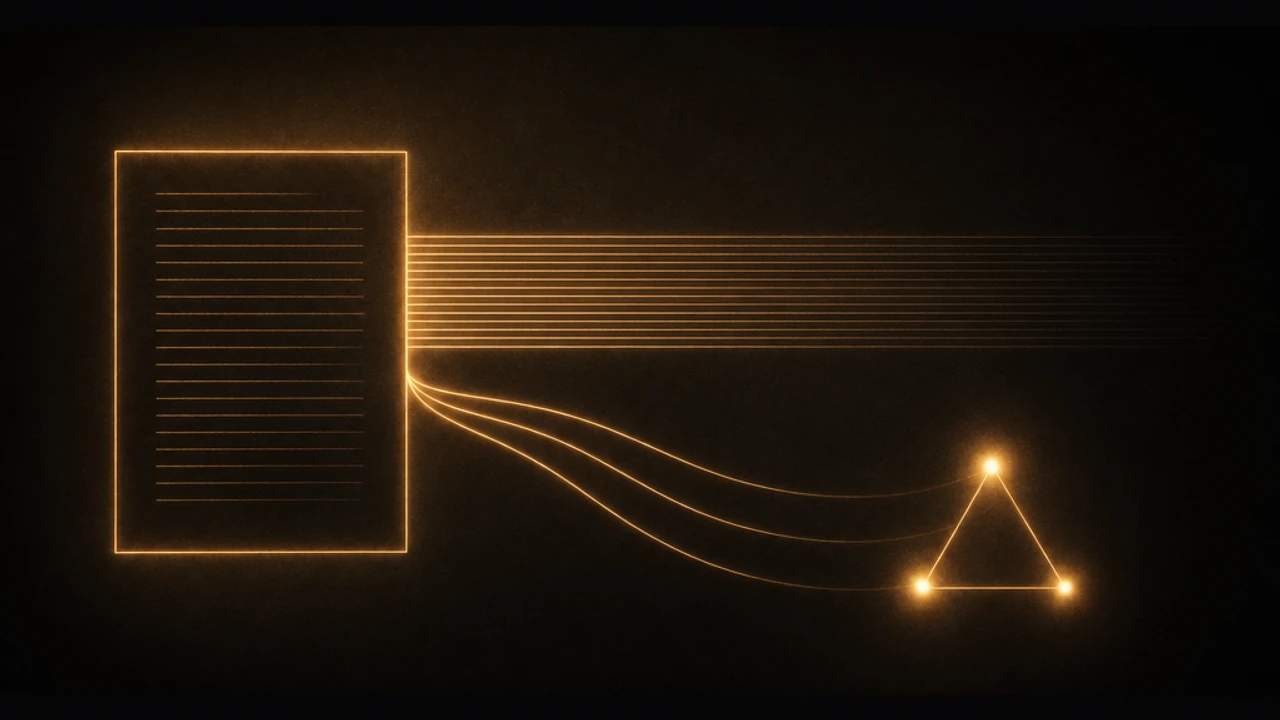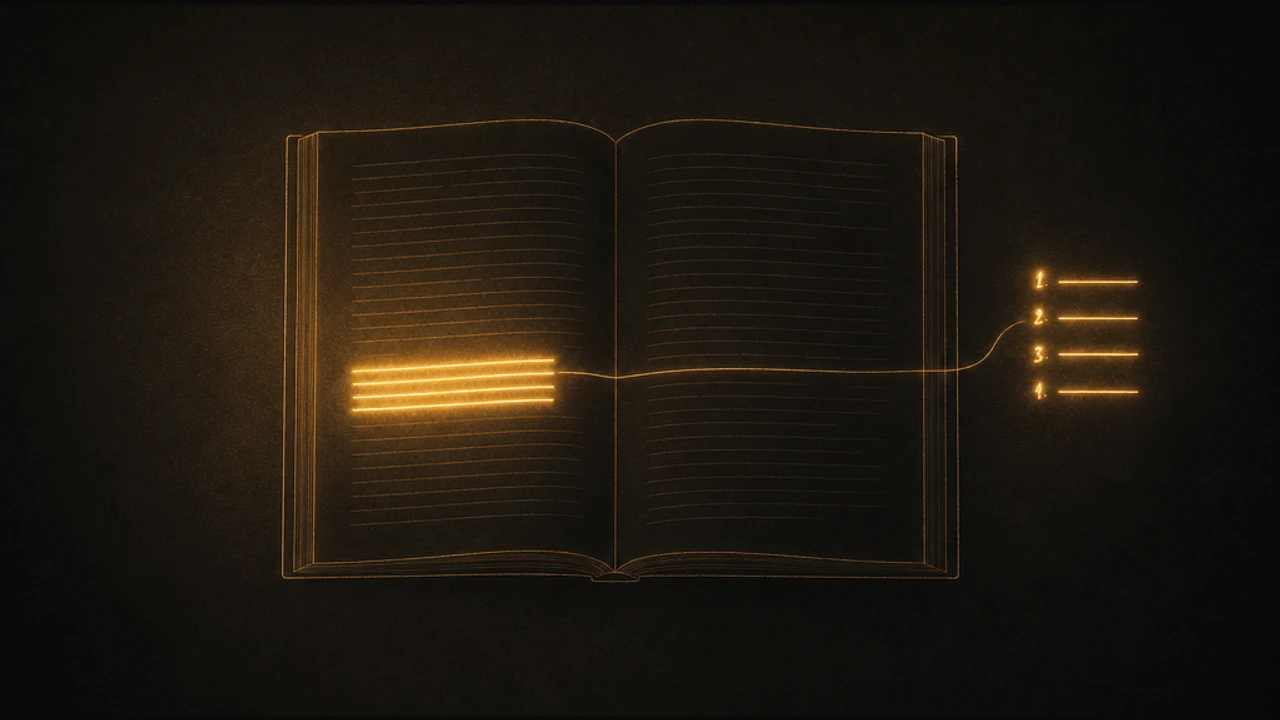
Annotate a book in two layers. While you read, mark only the passages you would want to find again, and keep the total small, because the research on marking shows the benefit shrinks as the marked share grows. Then, at the end of each chapter, write those page numbers on the inside of the back cover with three or four words each. The first layer costs nothing while you read. The second is the one that makes the book usable a year later, and it is the layer almost every annotation guide leaves out.
What does annotating a book actually mean?
Annotation is the note, not the color. A highlighter marks a location. An annotation says why that location matters: a word in the margin, a question mark, a page number pointing at the passage it contradicts. The distinction sounds pedantic until you open a book you marked two years ago and find forty yellow stripes with no record of what you were thinking.
This matters more for nonfiction than for fiction. Someone annotating a novel is usually marking how a sentence landed, and rereading it later is the entire point. Someone annotating an argument is building a tool. The tool has to answer a question you have not asked yet.
How much of a book should you mark?
Less than you currently do, and there is a measurement behind that. Fowler and Barker tested this in the Journal of Applied Psychology in 1974. Marking the text yourself beat reading a copy somebody else had already marked. And the more text a participant marked, the worse they did on the test.
The reason is the part worth carrying around. Marking does not add attention to a page, it redistributes it, and it cannot create attention you did not bring. A page going past you unread is a different failure. Later work found the trade running in both directions: readers did better on the material they had marked and worse on the material they had left alone (Blanchard and Mikkelson, 1987; Johnson, 1988). So every extra stripe is not free. It is borrowed from everything you did not mark.
That gives you a working rule with a reason attached. Mark a passage only if you can say, in one short sentence, what job it does in the argument. If you are marking more than about one passage every two pages, you have stopped selecting and started tracking your reading position.
Three questions that do the filtering quickly:
- Would this still matter to me in six months, or is it just well phrased?
- Can I state the claim in a sentence without looking at it?
- Does it change something I would actually do or decide?
Nothing here says marking is useless. It says marking is a pointer, and a pointer is only worth having if it is rare enough to stand out. The evidence on what marking does for memory on its own is covered in how to take notes on a book, which picks up where this post stops.
Does a color code help?
A color code is a filing system, and it earns its cost only if you sort by category later. If you use four colors and never once pull out all the blue passages, the colors were decoration with extra steps.
If you want one, keep it to three categories, because a system you have to remember is a system you will abandon in the middle of a hard chapter. A workable set for nonfiction: the claim, the evidence for it, and your own disagreement. Everything else goes unmarked or into a margin word.
It is also the part most likely to break. A scheme with five colors fails the first time a marker runs dry mid chapter, and again every time you pick up the book after a month away and cannot remember what pink meant.
One pen and a few margin symbols do the same work with less to maintain. A vertical line beside a paragraph for a core claim. A question mark for something you doubt. A box around a term the author is defining. An arrow with a page number for a passage that talks to another passage. The symbols carry the meaning that the colors were trying to carry, and you can add a new one mid book without buying anything.
How do you find a marked passage a year later?
This is the step the popular guides skip, and it is the one that decides whether annotating pays. Mortimer Adler solved it in an essay called "How to Mark a Book" for The Saturday Review of Literature, and the solution costs about a minute per chapter.
Use the back endpaper, the blank page inside the back cover, as a personal index. Each entry is a page number and three or four words in your own phrasing, listed in the order the points appear. When you finish the book, turn to the front endpaper and write the structure of the argument there: what the book claims, and the three or four moves it makes to get there.
The two pages do different jobs. The back index is for retrieval, so it is written in the wording you would search for, not the author's. The front outline is for judgment, and writing it forces you to state the argument with the book closed, which is the single most useful thing you can do with a finished book. If the outline will not come, you did not follow the argument, and the forty marked passages will not tell you that.
What do you do with the book after you finish it?
The marks are raw material. On their own they sit in the group of study techniques that a large 2013 review rated as low utility, next to rereading and summarizing, while self testing and spacing were the only two rated highly. That review is unpacked in how to remember what you read.
The cheap version of the good half takes ten minutes. Close the book, and write down what you can recall of the chapter without looking. Then open your back endpaper index and check what you missed. You are not copying passages, you are testing whether the argument survived the walk from the sofa to the kitchen. The gaps you find are exactly the pages worth rereading.
If you want the marked passages to become a collection you return to rather than a pile, that practice has a name and a few centuries of history behind it: see keeping a commonplace book.
How do you annotate a library book or one you do not want to mark?
Do not write in it. Beyond the obvious courtesy, a borrowed book you have annotated is a book whose annotations you lose on the return date.
The substitute is a strip of paper used as a bookmark, with page numbers and three or four words each, which is the same index Adler puts on the endpaper. Removable tabs work for the passages you want to reach instantly, as long as you stay under a handful per chapter. Sticky notes hold the longer thoughts, and they transfer to a notebook when the book goes back.
The reason this works about as well as writing in the margin is that the index was always doing the heavy lifting. The marks in the book were only ever pointing at it.
Can you annotate an ebook?
You can, and the mechanics are easier while the judgment gets harder. Kindle stores highlights and notes and shows them at read.amazon.com/notebook. Apple Books keeps them in the app under the book's notes tab. Both make marking a passage nearly free, which is precisely the condition under which people mark far too much.
Two limits are worth knowing before you rely on either. Publishers set a cap on how much of a book you may export, and you find out you crossed it only at the export, where the passage is replaced by a notice that you reached the clipping limit. And a digital highlight has no position on a physical page, so you lose the spatial memory that makes people say a passage was somewhere on the left, two thirds through. If you read mostly on a screen, the endpaper index becomes more important, not less. Keep it in one file with the same page or location numbers.
Tools exist to pull those highlights into one library and mail a few back each morning. They store well; whether the returning half works is the argument in Readwise alternatives.
What about audiobooks and podcasts?
Every method above assumes a page, a margin and a free hand. A large share of nonfiction now arrives as audio, and annotation has no analog there. You cannot underline a sentence you heard at 70 kilometers an hour, and by the time you could write it down the episode has moved on. What people do instead is nothing, which is why a year of listening leaves less behind than one carefully marked book.
I build Graspd for that case, so read this paragraph knowing who wrote it. Marking a moment while listening is one tap or one spoken sentence, the transcript around it is kept as the passage, and afterwards it asks you about what you marked instead of showing it back. The questions are capped at your listening position, so nothing later in the episode can leak into one. It is the endpaper index for audio.
The limits belong here too. Audible files carry DRM and cannot be imported by Graspd or any other third party tool, so this covers podcasts and audio you own outright. The free tier includes three hours of podcast audio a month, one recap and one quiz a week, and ten companion messages a day, and uploading your own files needs a paid plan. The capture problem in audio is worked through in how to remember what you listen to.
FAQ
How do you annotate a nonfiction book?
Mark the claims rather than the phrasing, and mark few of them. Put a vertical line beside a core claim, a question mark where you disagree, and a page number where one passage answers another. At the end of each chapter, list the page numbers you would defend on the inside of the back cover.
How much of a book should you highlight?
Little enough that the marks stand out on the page. Fowler and Barker found that among readers marking their own text, heavier marking went with worse test performance, so treat volume as a cost. One passage every couple of pages is plenty, and a chapter with nothing worth marking is a normal chapter.
Should you annotate in pen or pencil?
Pen if the book is yours and the note is a judgment you want to still see later, pencil if you expect to revise it or resell the book. The choice matters far less than whether you also keep a page number index, which is what makes any of the marks findable again.
Can you annotate a library book?
Not in the book itself. Use removable tabs for the passages you want to reach quickly and keep the index on a strip of paper that doubles as your bookmark, with a page number and three or four words per entry. When the book goes back, the strip is what you keep, and it holds almost everything the margin would have.
How do you annotate an audiobook?
You mark the moment instead of the page. Any app that drops a timestamped mark with one gesture will do, and the useful part comes afterwards, when you try to state what the marked moment said before replaying it. Graspd does this by keeping the transcript around each mark and quizzing you on it later.